NEW YORK—Having their sworn commitment to each other and all related rights therein recognized by the highest court of a sovereign U.S. state is ultimately not worth the hassle of moving to Iowa, longtime partners Danny Mindlin and Alex Small determined Monday. "Alex and I want to grow old together, but we'd have to drive six hours just to get a mezzaluna at Restoration Hardware," said Mindlin, who claimed he "couldn't survive" without a strawberry frosted cupcake from Amy's Bread after yoga every Thursday. "And where would we summer? Dubuque? I think we'll just buy a townhouse and live in an unrecognized union with beautiful granite countertops instead." The couple told reporters that their plans to adopt also weighed heavily in the decision, since they want to raise a child who is healthy, balanced, and "not tacky."
Wednesday, May 13, 2009
To Dubuque or Not Dubuque
From "The Onion: America's Finest News Source". My apologies to all Iowans but it appears some things just aren't worth moving for - even the Fifth Amendment!

Sunday, May 10, 2009
It's Just Another Day In the Hood
It is Mother's Day and I should be at some spa getting my nails painted, my back massaged, every once in a while sipping a relaxing cup of green tea - but I have two sick kids, hubby is away and so, I am housebound. Instead, I went looking for my daughter's "Baby" and in the process, gutted her room, then reorganised it - but why stop there? I redecorated it. I did not find Baby until I was finished. She conveniently appeared underneath the family room couch.
So - what next?
 How about cleaning the fridge? I decided to rummage through, throw anything old out (that's almost everything in my fridge) and upon doing so found some items of curiosity. Pickled asparagus. What do you do with pickled asparagus? What do you do with "vegetable spread"? Canned sour cherries? And how did these things end up in my fridge in the first place? I have a rule. If I can't think of what to do with something within 20 seconds, it goes in the garbage - so off they went, into the same trash can that has become home to most of what was in my daughter's room. It wasn't the way I expected to celebrate Mother's Day but, it was, in a strange way, enjoyable.
So - what next?
 How about cleaning the fridge? I decided to rummage through, throw anything old out (that's almost everything in my fridge) and upon doing so found some items of curiosity. Pickled asparagus. What do you do with pickled asparagus? What do you do with "vegetable spread"? Canned sour cherries? And how did these things end up in my fridge in the first place? I have a rule. If I can't think of what to do with something within 20 seconds, it goes in the garbage - so off they went, into the same trash can that has become home to most of what was in my daughter's room. It wasn't the way I expected to celebrate Mother's Day but, it was, in a strange way, enjoyable.
Sunday, April 12, 2009
Hero Steals the Headlines
I watched this story of a captain, selflessly giving himself up for his crew and was inspired. So often we hear stories of the "ugly American", but this time, this man - he is a true hero - the best of what America is. His country should be proud.


Thursday, April 9, 2009
You Can Be Too Famous...
Yet another (not so) great pretender. Tell me, what is it that makes a guy like this act like such a dufus? His own band looks embarrassed! This is what everyday people like me hate about Hollywood stars like him - this sense of entitlement and self-importance that seems to consume celebrities. They are holier-than-though one moment and selfish, ignorant clods the next - and nobody - I mean NOBODY - is allowed to call them on it. I am told it's the pressure of the business. I say it's the fact they have too much already - too much money, too much stuff and way too much attention - so much so that someone like Billy Bob Thorton would think his mediocre music (which, despite five albums, nobody has ever heard of) should stand on its own. Um, I don't think so Bad Santa...
Update: Billy Bob Thorton got his due with lashings from a Canadian audience - and that sent him packing. Good riddance!
Update: Billy Bob Thorton got his due with lashings from a Canadian audience - and that sent him packing. Good riddance!
Sunday, April 5, 2009
Wonders of the Sea
I played this repeatedly for my fascinated girls. Watch to the end because it is totally cool!
Tuesday, March 24, 2009
Perfectly Zen
I have told my husband many times that to curb my consumerism I only need perfection. Take my family room, for example (pictured below). Since renovating it, I have never felt the inclination to do anything else to it again - not add anything, change anything - just curl up on the couch and read a good book (off of one of my perfectly decorated bookshelves). Oh please don't roll your eyes. Can you not see the logic here? When something truly becomes "us" - whether it be our clothes, our space, our food, etcetera, we discover a peace and inner balance that wasn't there before. We love ourselves, our lives seem good again - if only in that outfit or that room or whatever.

Over the next two years, hubby and I are going to do some extensive renovations to our cottage. Hubby built it with his dad so I have been told I absolutely cannot knock it down which, of course, is exactly what I want to do. This limitation has caused me much consternation as I absolutely HATE the current building - it's too close to the water, the ceilings are too low, the layout is awkward - and you cannot change any of those things unless you knock the entire thing down. It's a limiting factor that elicited some serious whining from me because I just couldn't imagine my zen calm without creating a whole new space. But I am a reasonable woman so I have decided to move on, to open myself up to the challenge - and to make a very imperfect space feel (almost) perfect. To toast my new attitude I decided to decorate the front porch (which won't be the front porch when I'm done with it) with some lovely planters and Canadian winter fauna. Ahhh. So zen.

I know. I know. The door needs some paint...

Over the next two years, hubby and I are going to do some extensive renovations to our cottage. Hubby built it with his dad so I have been told I absolutely cannot knock it down which, of course, is exactly what I want to do. This limitation has caused me much consternation as I absolutely HATE the current building - it's too close to the water, the ceilings are too low, the layout is awkward - and you cannot change any of those things unless you knock the entire thing down. It's a limiting factor that elicited some serious whining from me because I just couldn't imagine my zen calm without creating a whole new space. But I am a reasonable woman so I have decided to move on, to open myself up to the challenge - and to make a very imperfect space feel (almost) perfect. To toast my new attitude I decided to decorate the front porch (which won't be the front porch when I'm done with it) with some lovely planters and Canadian winter fauna. Ahhh. So zen.

I know. I know. The door needs some paint...
Tuesday, March 3, 2009
Monday, March 2, 2009
On Living the Truth

Relating to a previous post I had on spin and truth, I found this May 21st, 2005 Kenyon commencement address from David Foster Wallace, and found it absolutely fascinating - especially considering the choice he made for his own violent end. The speech gets to the heart of why we line up behind ideas without exploration and how education helps us learn to avoid that default position. Would love to hear your thoughts on it.
(If anybody feels like perspiring [cough], I'd advise you to go ahead, because I'm sure going to. In fact I'm gonna [mumbles while pulling up his gown and taking out a handkerchief from his pocket].) Greetings ["parents"?] and congratulations to Kenyon's graduating class of 2005. There are these two young fish swimming along and they happen to meet an older fish swimming the other way, who nods at them and says "Morning, boys. How's the water?" And the two young fish swim on for a bit, and then eventually one of them looks over at the other and goes "What the hell is water?"
This is a standard requirement of US commencement speeches, the deployment of didactic little parable-ish stories. The story ["thing"] turns out to be one of the better, less bullshitty conventions of the genre, but if you're worried that I plan to present myself here as the wise, older fish explaining what water is to you younger fish, please don't be. I am not the wise old fish. The point of the fish story is merely that the most obvious, important realities are often the ones that are hardest to see and talk about. Stated as an English sentence, of course, this is just a banal platitude, but the fact is that in the day to day trenches of adult existence, banal platitudes can have a life or death importance, or so I wish to suggest to you on this dry and lovely morning.
Of course the main requirement of speeches like this is that I'm supposed to talk about your liberal arts education's meaning, to try to explain why the degree you are about to receive has actual human value instead of just a material payoff. So let's talk about the single most pervasive cliché in the commencement speech genre, which is that a liberal arts education is not so much about filling you up with knowledge as it is about quote teaching you how to think. If you're like me as a student, you've never liked hearing this, and you tend to feel a bit insulted by the claim that you needed anybody to teach you how to think, since the fact that you even got admitted to a college this good seems like proof that you already know how to think. But I'm going to posit to you that the liberal arts cliché turns out not to be insulting at all, because the really significant education in thinking that we're supposed to get in a place like this isn't really about the capacity to think, but rather about the choice of what to think about. If your total freedom of choice regarding what to think about seems too obvious to waste time discussing, I'd ask you to think about fish and water, and to bracket for just a few minutes your skepticism about the value of the totally obvious.
Here's another didactic little story. There are these two guys sitting together in a bar in the remote Alaskan wilderness. One of the guys is religious, the other is an atheist, and the two are arguing about the existence of God with that special intensity that comes after about the fourth beer. And the atheist says: "Look, it's not like I don't have actual reasons for not believing in God. It's not like I haven't ever experimented with the whole God and prayer thing. Just last month I got caught away from the camp in that terrible blizzard, and I was totally lost and I couldn't see a thing, and it was fifty below, and so I tried it: I fell to my knees in the snow and cried out 'Oh, God, if there is a God, I'm lost in this blizzard, and I'm gonna die if you don't help me.'" And now, in the bar, the religious guy looks at the atheist all puzzled. "Well then you must believe now," he says, "After all, here you are, alive." The atheist just rolls his eyes. "No, man, all that was was a couple Eskimos happened to come wandering by and showed me the way back to camp."
It's easy to run this story through kind of a standard liberal arts analysis: the exact same experience can mean two totally different things to two different people, given those people's two different belief templates and two different ways of constructing meaning from experience. Because we prize tolerance and diversity of belief, nowhere in our liberal arts analysis do we want to claim that one guy's interpretation is true and the other guy's is false or bad. Which is fine, except we also never end up talking about just where these individual templates and beliefs come from. Meaning, where they come from INSIDE the two guys. As if a person's most basic orientation toward the world, and the meaning of his experience were somehow just hard-wired, like height or shoe-size; or automatically absorbed from the culture, like language. As if how we construct meaning were not actually a matter of personal, intentional choice. Plus, there's the whole matter of arrogance. The nonreligious guy is so totally certain in his dismissal of the possibility that the passing Eskimos had anything to do with his prayer for help. True, there are plenty of religious people who seem arrogant and certain of their own interpretations, too. They're probably even more repulsive than atheists, at least to most of us. But religious dogmatists' problem is exactly the same as the story's unbeliever: blind certainty, a close-mindedness that amounts to an imprisonment so total that the prisoner doesn't even know he's locked up.
The point here is that I think this is one part of what teaching me how to think is really supposed to mean. To be just a little less arrogant. To have just a little critical awareness about myself and my certainties. Because a huge percentage of the stuff that I tend to be automatically certain of is, it turns out, totally wrong and deluded. I have learned this the hard way, as I predict you graduates will, too.
Here is just one example of the total wrongness of something I tend to be automatically sure of: everything in my own immediate experience supports my deep belief that I am the absolute center of the universe; the realest, most vivid and important person in existence. We rarely think about this sort of natural, basic self-centeredness because it's so socially repulsive. But it's pretty much the same for all of us. It is our default setting, hard-wired into our boards at birth. Think about it: there is no experience you have had that you are not the absolute center of. The world as you experience it is there in front of YOU or behind YOU, to the left or right of YOU, on YOUR TV or YOUR monitor. And so on. Other people's thoughts and feelings have to be communicated to you somehow, but your own are so immediate, urgent, real.
Please don't worry that I'm getting ready to lecture you about compassion or other-directedness or all the so-called virtues. This is not a matter of virtue. It's a matter of my choosing to do the work of somehow altering or getting free of my natural, hard-wired default setting which is to be deeply and literally self-centered and to see and interpret everything through this lens of self. People who can adjust their natural default setting this way are often described as being "well-adjusted", which I suggest to you is not an accidental term.
Given the triumphant academic setting here, an obvious question is how much of this work of adjusting our default setting involves actual knowledge or intellect. This question gets very tricky. Probably the most dangerous thing about an academic education -- least in my own case -- is that it enables my tendency to over-intellectualize stuff, to get lost in abstract argument inside my head, instead of simply paying attention to what is going on right in front of me, paying attention to what is going on inside me.
As I'm sure you guys know by now, it is extremely difficult to stay alert and attentive, instead of getting hypnotized by the constant monologue inside your own head (may be happening right now). Twenty years after my own graduation, I have come gradually to understand that the liberal arts cliché about teaching you how to think is actually shorthand for a much deeper, more serious idea: learning how to think really means learning how to exercise some control over how and what you think. It means being conscious and aware enough to choose what you pay attention to and to choose how you construct meaning from experience. Because if you cannot exercise this kind of choice in adult life, you will be totally hosed. Think of the old cliché about quote the mind being an excellent servant but a terrible master.
This, like many clichés, so lame and unexciting on the surface, actually expresses a great and terrible truth. It is not the least bit coincidental that adults who commit suicide with firearms almost always shoot themselves in: the head. They shoot the terrible master. And the truth is that most of these suicides are actually dead long before they pull the trigger.
And I submit that this is what the real, no bullshit value of your liberal arts education is supposed to be about: how to keep from going through your comfortable, prosperous, respectable adult life dead, unconscious, a slave to your head and to your natural default setting of being uniquely, completely, imperially alone day in and day out. That may sound like hyperbole, or abstract nonsense. Let's get concrete. The plain fact is that you graduating seniors do not yet have any clue what "day in day out" really means. There happen to be whole, large parts of adult American life that nobody talks about in commencement speeches. One such part involves boredom, routine, and petty frustration. The parents and older folks here will know all too well what I'm talking about.
By way of example, let's say it's an average adult day, and you get up in the morning, go to your challenging, white-collar, college-graduate job, and you work hard for eight or ten hours, and at the end of the day you're tired and somewhat stressed and all you want is to go home and have a good supper and maybe unwind for an hour, and then hit the sack early because, of course, you have to get up the next day and do it all again. But then you remember there's no food at home. You haven't had time to shop this week because of your challenging job, and so now after work you have to get in your car and drive to the supermarket. It's the end of the work day and the traffic is apt to be: very bad. So getting to the store takes way longer than it should, and when you finally get there, the supermarket is very crowded, because of course it's the time of day when all the other people with jobs also try to squeeze in some grocery shopping. And the store is hideously lit and infused with soul-killing muzak or corporate pop and it's pretty much the last place you want to be but you can't just get in and quickly out; you have to wander all over the huge, over-lit store's confusing aisles to find the stuff you want and you have to maneuver your junky cart through all these other tired, hurried people with carts (et cetera, et cetera, cutting stuff out because this is a long ceremony) and eventually you get all your supper supplies, except now it turns out there aren't enough check-out lanes open even though it's the end-of-the-day rush. So the checkout line is incredibly long, which is stupid and infuriating. But you can't take your frustration out on the frantic lady working the register, who is overworked at a job whose daily tedium and meaninglessness surpasses the imagination of any of us here at a prestigious college.
But anyway, you finally get to the checkout line's front, and you pay for your food, and you get told to "Have a nice day" in a voice that is the absolute voice of death. Then you have to take your creepy, flimsy, plastic bags of groceries in your cart with the one crazy wheel that pulls maddeningly to the left, all the way out through the crowded, bumpy, littery parking lot, and then you have to drive all the way home through slow, heavy, SUV-intensive, rush-hour traffic, et cetera et cetera.
Everyone here has done this, of course. But it hasn't yet been part of you graduates' actual life routine, day after week after month after year.
But it will be. And many more dreary, annoying, seemingly meaningless routines besides. But that is not the point. The point is that petty, frustrating crap like this is exactly where the work of choosing is gonna come in. Because the traffic jams and crowded aisles and long checkout lines give me time to think, and if I don't make a conscious decision about how to think and what to pay attention to, I'm gonna be pissed and miserable every time I have to shop. Because my natural default setting is the certainty that situations like this are really all about me. About MY hungriness and MY fatigue and MY desire to just get home, and it's going to seem for all the world like everybody else is just in my way. And who are all these people in my way? And look at how repulsive most of them are, and how stupid and cow-like and dead-eyed and nonhuman they seem in the checkout line, or at how annoying and rude it is that people are talking loudly on cell phones in the middle of the line. And look at how deeply and personally unfair this is.
Or, of course, if I'm in a more socially conscious liberal arts form of my default setting, I can spend time in the end-of-the-day traffic being disgusted about all the huge, stupid, lane-blocking SUV's and Hummers and V-12 pickup trucks, burning their wasteful, selfish, forty-gallon tanks of gas, and I can dwell on the fact that the patriotic or religious bumper-stickers always seem to be on the biggest, most disgustingly selfish vehicles, driven by the ugliest [responding here to loud applause] (this is an example of how NOT to think, though) most disgustingly selfish vehicles, driven by the ugliest, most inconsiderate and aggressive drivers. And I can think about how our children's children will despise us for wasting all the future's fuel, and probably screwing up the climate, and how spoiled and stupid and selfish and disgusting we all are, and how modern consumer society just sucks, and so forth and so on.
You get the idea.
If I choose to think this way in a store and on the freeway, fine. Lots of us do. Except thinking this way tends to be so easy and automatic that it doesn't have to be a choice. It is my natural default setting. It's the automatic way that I experience the boring, frustrating, crowded parts of adult life when I'm operating on the automatic, unconscious belief that I am the center of the world, and that my immediate needs and feelings are what should determine the world's priorities.
The thing is that, of course, there are totally different ways to think about these kinds of situations. In this traffic, all these vehicles stopped and idling in my way, it's not impossible that some of these people in SUV's have been in horrible auto accidents in the past, and now find driving so terrifying that their therapist has all but ordered them to get a huge, heavy SUV so they can feel safe enough to drive. Or that the Hummer that just cut me off is maybe being driven by a father whose little child is hurt or sick in the seat next to him, and he's trying to get this kid to the hospital, and he's in a bigger, more legitimate hurry than I am: it is actually I who am in HIS way.
Or I can choose to force myself to consider the likelihood that everyone else in the supermarket's checkout line is just as bored and frustrated as I am, and that some of these people probably have harder, more tedious and painful lives than I do.
Again, please don't think that I'm giving you moral advice, or that I'm saying you are supposed to think this way, or that anyone expects you to just automatically do it. Because it's hard. It takes will and effort, and if you are like me, some days you won't be able to do it, or you just flat out won't want to.
But most days, if you're aware enough to give yourself a choice, you can choose to look differently at this fat, dead-eyed, over-made-up lady who just screamed at her kid in the checkout line. Maybe she's not usually like this. Maybe she's been up three straight nights holding the hand of a husband who is dying of bone cancer. Or maybe this very lady is the low-wage clerk at the motor vehicle department, who just yesterday helped your spouse resolve a horrific, infuriating, red-tape problem through some small act of bureaucratic kindness. Of course, none of this is likely, but it's also not impossible. It just depends what you what to consider. If you're automatically sure that you know what reality is, and you are operating on your default setting, then you, like me, probably won't consider possibilities that aren't annoying and miserable. But if you really learn how to pay attention, then you will know there are other options. It will actually be within your power to experience a crowded, hot, slow, consumer-hell type situation as not only meaningful, but sacred, on fire with the same force that made the stars: love, fellowship, the mystical oneness of all things deep down.
Not that that mystical stuff is necessarily true. The only thing that's capital-T True is that you get to decide how you're gonna try to see it.
This, I submit, is the freedom of a real education, of learning how to be well-adjusted. You get to consciously decide what has meaning and what doesn't. You get to decide what to worship.
Because here's something else that's weird but true: in the day-to day trenches of adult life, there is actually no such thing as atheism. There is no such thing as not worshipping. Everybody worships. The only choice we get is what to worship. And the compelling reason for maybe choosing some sort of god or spiritual-type thing to worship -- be it JC or Allah, bet it YHWH or the Wiccan Mother Goddess, or the Four Noble Truths, or some inviolable set of ethical principles -- is that pretty much anything else you worship will eat you alive. If you worship money and things, if they are where you tap real meaning in life, then you will never have enough, never feel you have enough. It's the truth. Worship your body and beauty and sexual allure and you will always feel ugly. And when time and age start showing, you will die a million deaths before they finally grieve you. On one level, we all know this stuff already. It's been codified as myths, proverbs, clichés, epigrams, parables; the skeleton of every great story. The whole trick is keeping the truth up front in daily consciousness.
Worship power, you will end up feeling weak and afraid, and you will need ever more power over others to numb you to your own fear. Worship your intellect, being seen as smart, you will end up feeling stupid, a fraud, always on the verge of being found out. But the insidious thing about these forms of worship is not that they're evil or sinful, it's that they're unconscious. They are default settings.
They're the kind of worship you just gradually slip into, day after day, getting more and more selective about what you see and how you measure value without ever being fully aware that that's what you're doing.
And the so-called real world will not discourage you from operating on your default settings, because the so-called real world of men and money and power hums merrily along in a pool of fear and anger and frustration and craving and worship of self. Our own present culture has harnessed these forces in ways that have yielded extraordinary wealth and comfort and personal freedom. The freedom all to be lords of our tiny skull-sized kingdoms, alone at the center of all creation. This kind of freedom has much to recommend it. But of course there are all different kinds of freedom, and the kind that is most precious you will not hear much talk about much in the great outside world of wanting and achieving and [unintelligible -- sounds like "displayal"]. The really important kind of freedom involves attention and awareness and discipline, and being able truly to care about other people and to sacrifice for them over and over in myriad petty, unsexy ways every day.
That is real freedom. That is being educated, and understanding how to think. The alternative is unconsciousness, the default setting, the rat race, the constant gnawing sense of having had, and lost, some infinite thing.
I know that this stuff probably doesn't sound fun and breezy or grandly inspirational the way a commencement speech is supposed to sound. What it is, as far as I can see, is the capital-T Truth, with a whole lot of rhetorical niceties stripped away. You are, of course, free to think of it whatever you wish. But please don't just dismiss it as just some finger-wagging Dr. Laura sermon. None of this stuff is really about morality or religion or dogma or big fancy questions of life after death.
The capital-T Truth is about life BEFORE death.
It is about the real value of a real education, which has almost nothing to do with knowledge, and everything to do with simple awareness; awareness of what is so real and essential, so hidden in plain sight all around us, all the time, that we have to keep reminding ourselves over and over:
"This is water."
"This is water."
It is unimaginably hard to do this, to stay conscious and alive in the adult world day in and day out. Which means yet another grand cliché turns out to be true: your education really IS the job of a lifetime. And it commences: now.
I wish you way more than luck.
Sunday, March 1, 2009
Sibling Conversation
Eight Year Old to Five Year Old: "What do you want to be?"
Five Year Old: "Normal. What do you want to be?"
Pause.
Eight Year Old: "Normal is nice but I think I'll be an explorer instead."
Five Year Old: "Normal. What do you want to be?"
Pause.
Eight Year Old: "Normal is nice but I think I'll be an explorer instead."
Friday, February 27, 2009
Spin Doctors Need Not Apply
It was with great interest I watched Obama’s address to Congress the other night, and then, of course, Bobby Jindal’s rebuttal. I wanted to hear what they would say, but more interestingly, what the general buzz would be afterwards. As much as everyone says they want to hear details, they want a roadmap, they want to understand, the reality is, in a media saturated, politically polarized world, all anyone wants is grab onto a headline and hit a home run – for or against you. Recall the presidential election? Recall the policy debates? Probably little comes to mind except perhaps “pallin’ around with terrorists”, “lipstick on a pig” or “you betcha”.
We live in a world where a few catchy words influence and define our thinking – not just in politics but in everyday life. There is so much information but only so much one person can absorb, so we edit and parse ideas and sentences, hoping we don’t lose something in the translation, but knowing full well we cannot possibly have the whole picture. But then, of course, nobody has time to care. Everyone is running off to the next event, the next meeting, the next whatever. Facts flash before us day in and day out with very little registering except for the odd catchphrase.
I look at business today, my world, for example. An e-mail longer than 2 very short paragraphs risks not getting read. A proposal in anything other than Powerpoint sits on someone’s desk only to make its eventual way to the garbage can. Nobody has time to have a complete thought let alone read someone else’s. I’ve seen many a deal go south because of a lack of understanding, of “busy-ness” clouding good judgment. I cannot help but wonder why banking execs, living so long in the fast lane, could not pause for a moment to think about what they were doing. I can imagine what must have happened. Between meetings and cocktails, a quick chat with colleagues, each assuring the other they were doing ok, none of them stopping to wonder if such a declaration was even remotely true.
There is too much information and not enough time to digest thoughtfully, to debate back and forth. When time is money, it is context that gets lost. There just aren't enough resources to get to the truth. I recently had an experience where a loved one went through mediation to settle a dispute with a shady former boss. What I witnessed was a legal system brushing aside facts, all parties opting for the convenience of veneer layered conclusions and a clean wrap-up. It was a disenchanting, almost disconnecting experience – as if I was watching a movie in which the good guy lost. Movies shouldn’t end that way, nor should legal cases but here we were, watching justice go blind, if only because it didn’t have time to care.
The devil's in the details, I say. Too bad institutions, corporate or otherwise don't have the appetite for it. Communication today assumes some level of ADD. But then that's the main purpose of my blogging - to keep myself from such influence, to ensure I am thorough about being thoughtful.
Many of my work associates tell me I play devil’s advocate on EVERYTHING. They are probably right. I don’t want to live in a world where life is governed by distorted one-liners, glossy buzzwords or spin room antics. I want to live in a world where ideas are given their rightful place in the courts of peoples’ minds, to be properly dissected and vetted and only then to be accepted or discarded as the truth. I want to be a truth-seeker, a BS-eliminator, a person devoutly of her own mind. I know that it’s important to go beyond the cursory. If I cannot analyze, I cannot understand. I think I’ll make that my mantra. I’ll repeat it every time I feel the seductive pull of the forgone conclusion or untested idea. If I’m lucky, I’ll become informed - and maybe, just maybe, if I’m really lucky, I’ll finally come face-to-face with the truth.
We live in a world where a few catchy words influence and define our thinking – not just in politics but in everyday life. There is so much information but only so much one person can absorb, so we edit and parse ideas and sentences, hoping we don’t lose something in the translation, but knowing full well we cannot possibly have the whole picture. But then, of course, nobody has time to care. Everyone is running off to the next event, the next meeting, the next whatever. Facts flash before us day in and day out with very little registering except for the odd catchphrase.
I look at business today, my world, for example. An e-mail longer than 2 very short paragraphs risks not getting read. A proposal in anything other than Powerpoint sits on someone’s desk only to make its eventual way to the garbage can. Nobody has time to have a complete thought let alone read someone else’s. I’ve seen many a deal go south because of a lack of understanding, of “busy-ness” clouding good judgment. I cannot help but wonder why banking execs, living so long in the fast lane, could not pause for a moment to think about what they were doing. I can imagine what must have happened. Between meetings and cocktails, a quick chat with colleagues, each assuring the other they were doing ok, none of them stopping to wonder if such a declaration was even remotely true.
There is too much information and not enough time to digest thoughtfully, to debate back and forth. When time is money, it is context that gets lost. There just aren't enough resources to get to the truth. I recently had an experience where a loved one went through mediation to settle a dispute with a shady former boss. What I witnessed was a legal system brushing aside facts, all parties opting for the convenience of veneer layered conclusions and a clean wrap-up. It was a disenchanting, almost disconnecting experience – as if I was watching a movie in which the good guy lost. Movies shouldn’t end that way, nor should legal cases but here we were, watching justice go blind, if only because it didn’t have time to care.
The devil's in the details, I say. Too bad institutions, corporate or otherwise don't have the appetite for it. Communication today assumes some level of ADD. But then that's the main purpose of my blogging - to keep myself from such influence, to ensure I am thorough about being thoughtful.
Many of my work associates tell me I play devil’s advocate on EVERYTHING. They are probably right. I don’t want to live in a world where life is governed by distorted one-liners, glossy buzzwords or spin room antics. I want to live in a world where ideas are given their rightful place in the courts of peoples’ minds, to be properly dissected and vetted and only then to be accepted or discarded as the truth. I want to be a truth-seeker, a BS-eliminator, a person devoutly of her own mind. I know that it’s important to go beyond the cursory. If I cannot analyze, I cannot understand. I think I’ll make that my mantra. I’ll repeat it every time I feel the seductive pull of the forgone conclusion or untested idea. If I’m lucky, I’ll become informed - and maybe, just maybe, if I’m really lucky, I’ll finally come face-to-face with the truth.
Wednesday, February 25, 2009
Saturday, February 21, 2009
My Absence Is Merely A Sign of the Times
My apologies to those visitors wondering where all the posts have gone. I have been a negligent blogger of late. Work is very demanding thanks, of course, to the deteriorating economy and clients’ tightening purse strings. That means we are all working twice as hard for the same business.
There’s a sign above the exit of one the “modules” in our office building that says “Nobody ever said on their deathbed they wish they spent more time at the office.” But here I am doing exactly that, day and night spent trying to find out where our next piece of business is going to come from. And with the vast majority of my work sent to India, my days are even longer, as I meet with colleagues half way around the world, early in the morning, late at night. All of us are scared, all of us all over the world, wondering what will come of the next year – will things bounce back or will the economy completely unravel? Will we be here, amongst other heads-down toiling workers or will we be another nameless face in a long unemployment line?
Our company recently announced their 2008 fourth quarter results and 2009 outlook. Ours was a modest performance but the stock market, so desperate for good news, rewarded the disclosure with a 300 point bump on the NY Stock Exchange! Yes, I work for a very big company, but this is still quite a feat considering Obama’s inauguration couldn’t breathe even a glimmer of hope into the markets.
These are difficult times - but I don't feel the worst of it. So many others have far greater difficulties to attend to - where to get a job, how to feed their kids. People ask me how I am these days - and I say "very busy". It used to be a comment that would elicit sympathy, as if one should be more relaxed, on a permanent vacation. But these days, it gets a much different response. "You're lucky" I'm told. Yes, indeed. I am very lucky.
So if you’re wondering where I’ve been, I’m still here, more sporadic than usual, but still here, working away, doing my best to outlast 2009. Cross your fingers for me, yourself and everyone else out there. It’s a long, tight race but I’m hoping for the best.
There’s a sign above the exit of one the “modules” in our office building that says “Nobody ever said on their deathbed they wish they spent more time at the office.” But here I am doing exactly that, day and night spent trying to find out where our next piece of business is going to come from. And with the vast majority of my work sent to India, my days are even longer, as I meet with colleagues half way around the world, early in the morning, late at night. All of us are scared, all of us all over the world, wondering what will come of the next year – will things bounce back or will the economy completely unravel? Will we be here, amongst other heads-down toiling workers or will we be another nameless face in a long unemployment line?
Our company recently announced their 2008 fourth quarter results and 2009 outlook. Ours was a modest performance but the stock market, so desperate for good news, rewarded the disclosure with a 300 point bump on the NY Stock Exchange! Yes, I work for a very big company, but this is still quite a feat considering Obama’s inauguration couldn’t breathe even a glimmer of hope into the markets.
These are difficult times - but I don't feel the worst of it. So many others have far greater difficulties to attend to - where to get a job, how to feed their kids. People ask me how I am these days - and I say "very busy". It used to be a comment that would elicit sympathy, as if one should be more relaxed, on a permanent vacation. But these days, it gets a much different response. "You're lucky" I'm told. Yes, indeed. I am very lucky.
So if you’re wondering where I’ve been, I’m still here, more sporadic than usual, but still here, working away, doing my best to outlast 2009. Cross your fingers for me, yourself and everyone else out there. It’s a long, tight race but I’m hoping for the best.
Sunday, February 8, 2009
Rivalry Makes the Champion
 If you’re a tennis fan, these last two years have been champagne seasons as mens’ tennis experiences a magnificent renaissance, thanks in no small part to the rivalry of Roger Federer and Raphael Nadal. I admit, a few years ago I had almost given up my devotion to the game; with the advancement of racquet and fitness technologies, it had become a boring robotic baseline exchange.
I thought the magic that was men’s tennis had truly passed; recall those days when Bjorn Borg would duel John McEnroe, their matches, still considered the best ever. As the years went on, tennis lost its polish, partly due to the advances mentioned above and partly due to the money that came into the sport. Players could survive on fewer tournaments, spending idle time cavorting off court.
 Even those on court weren’t particularly interested in being there. Have you ever heard of “Maybe the Moon”? It was the book Jim Courier so famously pulled out on changeovers at an ATP Tour event in Frankfurt in 1993. If you are speculating whether the book contained useful nuggets of tennis inspiration, consider the plot which the New York Times summarized as follows:
 "Hollywood can be a cruel place, especially for Cady Roth, an overweight dwarf who longs to escape her stereotyped role in a famous film."
At 6’1”, I doubt an athlete like Courier could have used advice from a chubby dwarf.
There were more displays of disinterest – Sampras skipping the Davis Cup, Agassi skipping grand slams, nobody interested, nobody invested. I know Sampras rang up 14 grand slams, still a record today, but considering the lethargy that was the men’s game at that time, I’m just not that impressed. The sport lost its gloss – indeed, it lost its lead status as the weekend athlete's pastime of choice - and became the bridesmaid to golf’s blooming bride.
 Then came Federer, a ghost of tennis past, a smooth and effortless hero, with strokes harking back to the days when tennis was more poetry than power. The tennis world, in an instant, fell in love. He was soon baptized the saviour of the ATP as fans lined up to watch him pull out one impossible shot after another. It’s cliché that rings true when I say he had it all – grace and speed, finesse and power, the gentle demeanor of true sportsman. He was of incomparable talent, so exceptional, that when Nike aired commercials of Federer in competitive stand-off, it was not against another tennis player, but rather golfer, and fellow sports god, Tiger Woods.
Everything about Federer was soon tagged with labels of greatness – greatest forehand in the game, the greatest serve in the game, the greatest footwork in the game, the greatest volley in the game - and when he was dissected to his smallest piece parts, analysts went back to the whole and asked if he was the greatest player in the game. It was in easy agreement that all would say yes but still, it did not seem enough to describe the wonder that he was. Could he, as one writer postulated and many more later proposed, could he be the greatest player EVER? It was at this point, at the consideration of his historical significance that experts of the game started to question his credibility. The doubt lay not in his raw skills which were obvious and unparalleled, but rather in his heart, yet unchallenged: was it one of a true champion?
How could we know of his heart, if he didn’t have a rival to challenge it, to try and break him and to push him to the edge? Tennis fans began to wonder if they were going to have to watch Federer march slowly into history books, unbalanced and unchecked, his greatness never really tested for lack of a worthy opponent.
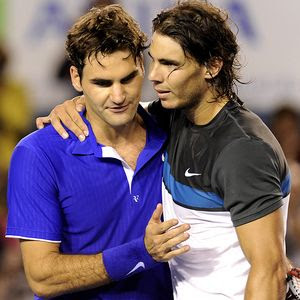
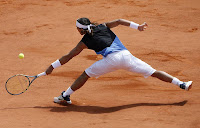 Enter Nadal, arriving perhaps a couple of years late, on the slight back-end of the Federer cusp, but arriving nonetheless, a feisty, power baseliner; but not a player like we’ve seen before – he had more speed, more court sense and a lot more heart. He would prove to be the required nemesis for Federer – power to finesse, passion testing cool collectedness. The rivalry was fruitful and fans have since been treated to some of the most outstanding tennis in history, the Wimbledon 2008 finals now considered by many to be the best ever.
It is true that Nadal’s record against Federer is more impressive than vice versa – but he is still far behind in total wins. All records still lead to Federer - it was only ever a question of worthiness, but now, with an opponent to match the prestige, Federer’s wins started to mean something. His 2007 Wimbledon win was so much more credible in 2008 after he lost to Nadal – as if his vulnerability somehow proved that it did, indeed, take heart to win the ones he did.
Nadal has the edge now – his record has been almost spotless against Federer these last two years. He is also much younger at his physical peak of age 21. Federer who is turning 28 this year is no doubt, in the sunset of his career. Federer, however, has Nadal to thank for elevating his status in the game, if only because Nadal helped find him find his inner-gladiator. Through the long stretched rallies and impossible volleys, through the marathon matches and heartbreaking losses, Federer, finally became a true champion.
I don’t want you to think I’m closing the book here. This rivalry still has legs. As Federer comes back from his bout with mono, I expect him to throw everything he has into winning Grand Slam #14 and then #15. Nadal will be doing the same. They are impossibly talented athletes, with great respect for the one other, their contrasting styles and personalities providing the intrigue that together, make them so fascinating to watch. They have immortality on the line in each and every match – both chasing history, both destined for the record books. And I am so glad to be part of it, to witness such a rarity, the once-in-a-lifetime occurrence of two players arriving in synchronicity, just in time to lead the other to greatness.
At 6’1”, I doubt an athlete like Courier could have used advice from a chubby dwarf.
There were more displays of disinterest – Sampras skipping the Davis Cup, Agassi skipping grand slams, nobody interested, nobody invested. I know Sampras rang up 14 grand slams, still a record today, but considering the lethargy that was the men’s game at that time, I’m just not that impressed. The sport lost its gloss – indeed, it lost its lead status as the weekend athlete's pastime of choice - and became the bridesmaid to golf’s blooming bride.
 Then came Federer, a ghost of tennis past, a smooth and effortless hero, with strokes harking back to the days when tennis was more poetry than power. The tennis world, in an instant, fell in love. He was soon baptized the saviour of the ATP as fans lined up to watch him pull out one impossible shot after another. It’s cliché that rings true when I say he had it all – grace and speed, finesse and power, the gentle demeanor of true sportsman. He was of incomparable talent, so exceptional, that when Nike aired commercials of Federer in competitive stand-off, it was not against another tennis player, but rather golfer, and fellow sports god, Tiger Woods.
Everything about Federer was soon tagged with labels of greatness – greatest forehand in the game, the greatest serve in the game, the greatest footwork in the game, the greatest volley in the game - and when he was dissected to his smallest piece parts, analysts went back to the whole and asked if he was the greatest player in the game. It was in easy agreement that all would say yes but still, it did not seem enough to describe the wonder that he was. Could he, as one writer postulated and many more later proposed, could he be the greatest player EVER? It was at this point, at the consideration of his historical significance that experts of the game started to question his credibility. The doubt lay not in his raw skills which were obvious and unparalleled, but rather in his heart, yet unchallenged: was it one of a true champion?
How could we know of his heart, if he didn’t have a rival to challenge it, to try and break him and to push him to the edge? Tennis fans began to wonder if they were going to have to watch Federer march slowly into history books, unbalanced and unchecked, his greatness never really tested for lack of a worthy opponent.
 Enter Nadal, arriving perhaps a couple of years late, on the slight back-end of the Federer cusp, but arriving nonetheless, a feisty, power baseliner; but not a player like we’ve seen before – he had more speed, more court sense and a lot more heart. He would prove to be the required nemesis for Federer – power to finesse, passion testing cool collectedness. The rivalry was fruitful and fans have since been treated to some of the most outstanding tennis in history, the Wimbledon 2008 finals now considered by many to be the best ever.
It is true that Nadal’s record against Federer is more impressive than vice versa – but he is still far behind in total wins. All records still lead to Federer - it was only ever a question of worthiness, but now, with an opponent to match the prestige, Federer’s wins started to mean something. His 2007 Wimbledon win was so much more credible in 2008 after he lost to Nadal – as if his vulnerability somehow proved that it did, indeed, take heart to win the ones he did.
Nadal has the edge now – his record has been almost spotless against Federer these last two years. He is also much younger at his physical peak of age 21. Federer who is turning 28 this year is no doubt, in the sunset of his career. Federer, however, has Nadal to thank for elevating his status in the game, if only because Nadal helped find him find his inner-gladiator. Through the long stretched rallies and impossible volleys, through the marathon matches and heartbreaking losses, Federer, finally became a true champion.
I don’t want you to think I’m closing the book here. This rivalry still has legs. As Federer comes back from his bout with mono, I expect him to throw everything he has into winning Grand Slam #14 and then #15. Nadal will be doing the same. They are impossibly talented athletes, with great respect for the one other, their contrasting styles and personalities providing the intrigue that together, make them so fascinating to watch. They have immortality on the line in each and every match – both chasing history, both destined for the record books. And I am so glad to be part of it, to witness such a rarity, the once-in-a-lifetime occurrence of two players arriving in synchronicity, just in time to lead the other to greatness.
Wednesday, February 4, 2009
This Is Not a Cop-out
 You must read it - background for my next post on rivalries. This article was written in 2006 by the late, great, David Foster Wallace. "Roger Federer As Religious Experience". It's background because he plays soothsayer, predicting the opponent Federer would have in Nadal. It's a must read because it's sportswriting elevated to art. I cannot think of a sports article written with more eloquence and revelation than this one. DFW was an accomplished tennis player, technically astute with respect to the mechanics of the game and, of course, he was a master storyteller - both are evident in the perspective he brought here. I wouldn't want to have been on the opposite side of him - either on the court or on the page. Greatness must have its rivals (as you'll see in my next post) but where DFW is concerned, it's certainly not me!
Tuesday, February 3, 2009
Russell Peters On Indians and Canadians
For all my Indian buddies who have spent the last few years putting up with us Canadians, this one's for you:
Monday, February 2, 2009
Toboggan Ride
I was thrilled for a break in the weather today – this is what winter is supposed to be like – perfect packing snow and warm air. We (hubby, kids, Tucker and I) decided to go tobogganing on a nearby hill. The larger ones were congested with kids, (BIG kids) sweeping down with frightening speed, soaring over huge kid-made snow ramps. I had visions, none of them good, so off we went to another hill. It wasn’t nearly as tall but we had it all to ourselves. The girls used different sleds to test their speed, the faster, the better, of course.
They’re all getting older now. It seems like yesterday they were tots on their first toboggan ride. That first experience was not an easy one, a painful chore for all if I recall. I remember dragging child and sled together up the hill run after run, my legs tired from carrying both, the girls crying because either we went too fast or we crashed or it was just plain cold.
I like the phase they’re in now. They’re directing more, active in their own learning. I feel more like a participant in than an author of their lives. There was so much protecting before, but now it’s all coaching and encouragement. Things aren’t necessarily easier – homework and piano are growing hurdles, but here on the hill, watching them scream with delight, I can’t help but think how much I love this moment. I am soaking it in, their zeal and their smiles, their bantering and play. It’s a lovely warm day and I’m so glad we got out together.
They’re all getting older now. It seems like yesterday they were tots on their first toboggan ride. That first experience was not an easy one, a painful chore for all if I recall. I remember dragging child and sled together up the hill run after run, my legs tired from carrying both, the girls crying because either we went too fast or we crashed or it was just plain cold.
I like the phase they’re in now. They’re directing more, active in their own learning. I feel more like a participant in than an author of their lives. There was so much protecting before, but now it’s all coaching and encouragement. Things aren’t necessarily easier – homework and piano are growing hurdles, but here on the hill, watching them scream with delight, I can’t help but think how much I love this moment. I am soaking it in, their zeal and their smiles, their bantering and play. It’s a lovely warm day and I’m so glad we got out together.
Friday, January 30, 2009
Considering Ayn Rand and Motherhood
 I have been doing some reading and re-reading on Ayn Rand – reminding myself of the philosophies borne out of books like Atlas Shrugged and Fountainhead. She was a fascinating woman, analytical, forthright, vocal and very, very smart. I still cannot open any one of her works without feeling a little bit intimidated. That said, I always welcome the challenge her ideas invite and the way they turn my sometimes conventional thinking upside down.
 Rand was a writer and a playwright whose ideas were borne out of Aerstotilian ethics, the concept that individuals have nobility and they have a duty to realize their potential. Her philosophy she called “objectivism” and she described it as the concept of "man being a “heroic” being with the moral purpose of his life being his own happiness and reason as his only absolute". Central to her ideas were the concepts of selfishness and altruism. Selfishness, she claimed was the ultimate moral act for an individual, that one could not assume responsibility of his or her own happiness without it.
Altruism, on the contrary, was evil. She defined it as “sacrificing of yourself to someone else in such a way that you are placing their interests ahead of your own.” What is wrong with that, I would have liked to ask? “What is wrong with suicide?” she’d say. “What is wrong with giving up life? And why is the happiness of another person important and good but not your own? Why are you the outsider or sacrificial animal? In a good relationship there should be no victims, no sacrifices.”
It’s an odd thing to think about - the evils of altruism – but I decided to explore it a bit, from my own vantage point, as a mother - a great case study, I thought, given there is no competition more obsessed over than the relative martyrdom of mothers. Who has done more, who hasn’t done enough, who gave up their career to care for their children, who built a career to better provide for their children? It’s a circular argument that has gone on for decades, but has been especially vitriolic these last eight neo-con dominated years.
What is interesting is that, while we mothers argue about who has made the greater sacrifice, Ayn Rand tells us we have made no sacrifice at all – that if we love someone, then we get something out of it (children providing love and generational continuity) and that, by definition, is selfish.
A truly altruistic mother would stay at home with or work for someone else’s children but not her own. A truly altruistic wife would pay for cancer treatment for someone else’s spouse but not her own. A martyr, an altruist, does not place their interests above those of others and does not respect their moral obligation to themselves and their own happiness (their loved ones being an adjunct to themselves).
And so, she concludes, we must accept selfishness as a personal responsibility.
It all sounds so callous. I don’t think she ever had children so I can only guess at how her thinking might have evolved. She may have benefited from spending a day with someone like me. I don’t feel particularly good when I’m scolding my girls to practice piano, to finish their homework or clean up their mess - but I can’t decide if I’m being selfish for wanting their success or altruistic for letting them to drive me crazy:)
I do think exploring objectivism against our everyday values is a worthy exercise, to put accepted thinking to the test. It certainly helped me appreciate the hypocrisy of the whole “mothering” argument. But I do believe that mothers feel a sacrifice. I do think that no choice is perfectly selfish or altruistic. There are always regrets and what-ifs and what-could-have-beens. I believe this is what really ignites the “mothering” argument and perhaps what casts a shadow on Rand’s philosophy – that choosing a fork in a road is not so black and white, that even if one acknowledges the merits of a selfish act, acts out in a selfish way, one cannot necessarily conclude that, they had indeed, been selfish.
It’s a complicated argument, a great forum for discussion - I know I’ve only scratched the surface – I’d love to go on but, then with whom? I am reminded of a chapter in Alan Greenspan’s book, Age of Turbulence (great book by the way), where he mentions weekly parlour parties hosted by Ayn Rand with some of the smartest minds in New York, Greenspan among them, sitting around her apartment, smoking, drinking, debating the latest philosophical and political ideas. It would have been the coolest experience, to debate with Ayn Rand. Unfortunately, I won’t benefit from such a connection. But I still have her ideas. And I’ll continue to test them against conventional thinking, just as I did with motherhood. Maybe she’ll surprise me again as she did this time. Indeed, I was only too happy to learn I am no martyr. It was too much of a burden anyway.
Thursday, January 29, 2009
Wednesday, January 28, 2009
Sarah Save Thyself
I am often asked why I never chose to write of Sarah Palin in any of my posts, that her omission seemed a glaring oversight given my obvious love of all things political. Well, my simple answer is that, as a candidate, Sarah Palin never much interested me. Other than initial surprise, she didn't bring anything that could hold my interest, save perhaps her motherhood – but then, I’ve never felt compelled to write about someone just because they’re a mother.
So, I find myself in an awkward position, asked to extend Sarah’s time in the sun, to elongate her campaign for notoriety and media presence, something she seems hell bent on doing till 2012. Quite frankly, I’d rather be the one helping to sunset that fifteen minutes of fame. I see no better way to do that than by simply ignoring her. To remove her from the spotlight is to tell her that time is up; go home and feed the dogs.
Of course, the problem is Sarah won’t go home. She won’t go away. She fights to maintain celebrity-style attention, hoping against hope that she can redeem herself from the embarrassing and sometimes bizarre behaviour she displayed during the election. I’m not sure more time in front of the camera is the answer. It’s a medium that has only served to perpetuate an already established caricature – that she is a politically thirsty neophyte, unworldly in her perspective, uneducated in her views; that she is someone who appears to lack depth on the very issues that, as a leader, she'd be called upon to address. She is someone for whom the Peter Principle crown would be aptly bestowed: “in a hierarchy, every employee rises to his or her level of incompetence”.
If I were Sarah, I’d recognize my shortcomings, then aggressively go about closing that capability gap. I’d read books (and yes, newspapers). I’d sign up for committees - on energy, foreign policy, the economy (and yes, I know she was on an energy committee but she's clearly in need of more education). I’d make friends with knowledgeable people. I’d create relationships with leading businesses - listen to what they need, ask where they want to take America. I’d establish relationships with foreign leaders. I’d visit them, even if it meant an overnight flight! I’d gather information on their successes; I’d learn about their failures; I’d understand their challenges and ask what they needed from America. If I were Palin, I’d use these four years to LEARN. It's the five letter word that should become her mantra and it's the one thing that could reinvent her and make her credible. Times are too stark and too serious for someone lacking intellectual fortitude. If Sarah wants America to take her seriously, it’s high time she did so herself.
So, I find myself in an awkward position, asked to extend Sarah’s time in the sun, to elongate her campaign for notoriety and media presence, something she seems hell bent on doing till 2012. Quite frankly, I’d rather be the one helping to sunset that fifteen minutes of fame. I see no better way to do that than by simply ignoring her. To remove her from the spotlight is to tell her that time is up; go home and feed the dogs.
Of course, the problem is Sarah won’t go home. She won’t go away. She fights to maintain celebrity-style attention, hoping against hope that she can redeem herself from the embarrassing and sometimes bizarre behaviour she displayed during the election. I’m not sure more time in front of the camera is the answer. It’s a medium that has only served to perpetuate an already established caricature – that she is a politically thirsty neophyte, unworldly in her perspective, uneducated in her views; that she is someone who appears to lack depth on the very issues that, as a leader, she'd be called upon to address. She is someone for whom the Peter Principle crown would be aptly bestowed: “in a hierarchy, every employee rises to his or her level of incompetence”.
If I were Sarah, I’d recognize my shortcomings, then aggressively go about closing that capability gap. I’d read books (and yes, newspapers). I’d sign up for committees - on energy, foreign policy, the economy (and yes, I know she was on an energy committee but she's clearly in need of more education). I’d make friends with knowledgeable people. I’d create relationships with leading businesses - listen to what they need, ask where they want to take America. I’d establish relationships with foreign leaders. I’d visit them, even if it meant an overnight flight! I’d gather information on their successes; I’d learn about their failures; I’d understand their challenges and ask what they needed from America. If I were Palin, I’d use these four years to LEARN. It's the five letter word that should become her mantra and it's the one thing that could reinvent her and make her credible. Times are too stark and too serious for someone lacking intellectual fortitude. If Sarah wants America to take her seriously, it’s high time she did so herself.
Here We Go Again!

I'm looking out my window at yet another snowstorm - apparently fifteen centimeters when all is done this evening. School was cancelled, businesses closed early. This lousy weather is getting to be too much of a habit! I did manage to trek outside for a short time. I thought I'd make it to our head office, normally an hour away from my house but more like an eternity today, I realised it once on the highway. It was a mess, more cars in the ditch than on the road. The snow was thick and slippery, my tires no match for for the frictionless surface built up. So heavy was the accumulation, I could hardly see out my windshield, even as the wipers brushed snow aside. I remember an auto insurance exec once telling me that on these days they all sit in their offices shivering - honestly, the claims they pay out because of peoples' stubbornness! I would have been one of them today - I had an important meeting I should have attended, however a car spiraled out of control in front of me, causing me to fishtail to the side. "Enough driving for one day" I said to myself and I headed to the nearest exit. Once home, I happily set up shop for the rest of the day. My computer on my lap, a hot mug of green tea warming my hands and Nina Simone playing in the background. What could be better on such a lousy day?
Subscribe to:
Posts (Atom)